EasyRead

Read English papers
as comfortable Chinese

Import a PDF and let the Claude Code or Codex you already use, or a free model, translate it page by page in the background. Equations and tables keep their layout, the original page is always beside you, and you can highlight, take notes and ask AI as you read.

Heads-up: EasyRead translates English → Chinese and its interface is in Chinese. It's made for Chinese-speaking students and researchers.

Free and open source · Runs locally, your papers and notes stay on your computer

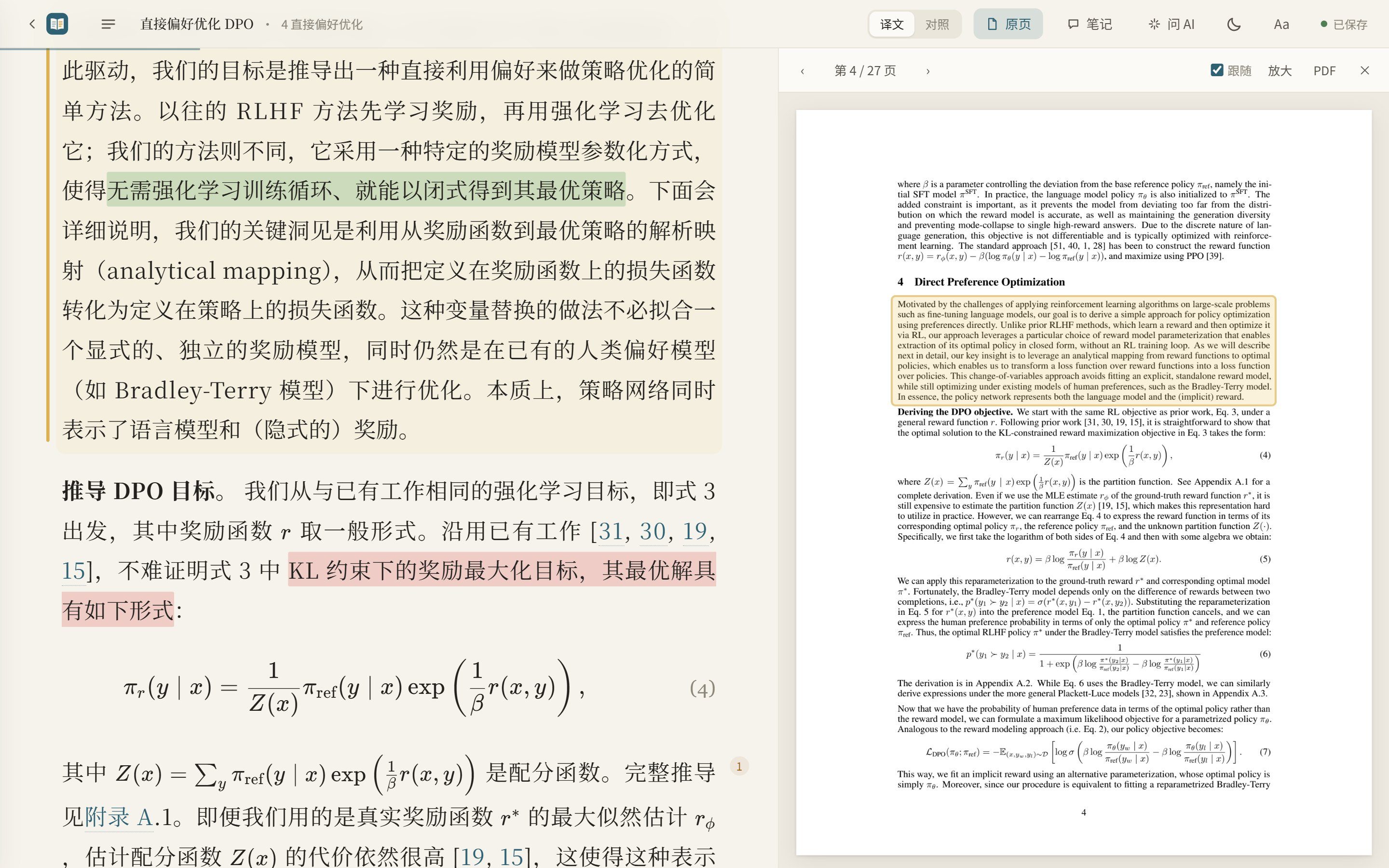
Reader: translation on the left, original page on the right

Not just “throw the PDF into a translator”

A translator gives you a pile of broken lines. EasyRead gives you a typeset Chinese paper you can annotate and question.

Reads like a typeset book

Serif body text and a comfortable measure. Equations re-rendered with KaTeX, clean three-line tables, references left in the original.

Check the original anytime

Toggle bilingual mode to see the English under each paragraph; the original page follows your position and boxes the current paragraph.

Translation ≠ commentary

The main text is only the faithful translation. AI explanations and typos it spots in the source go in the margin.

Ask AI as you read

Quote several paragraphs in one question. Ask about “the ones I marked in red” and it finds your red highlights.

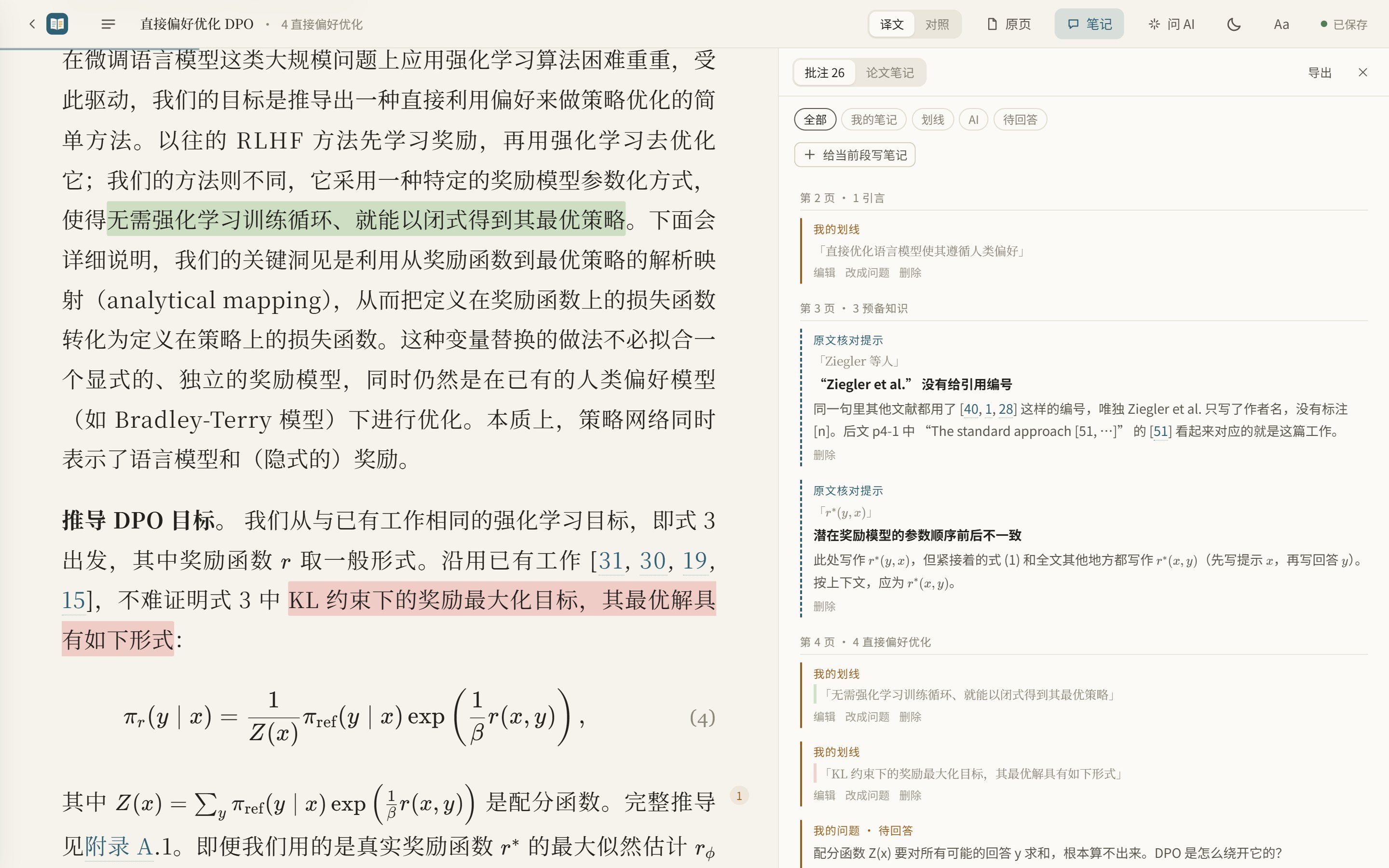
Highlights, notes, questions

Four highlighter colors or underline. Send a question to AI in one click. Everything collected in reading order, exportable to Markdown.

Not just arXiv

Drop in any PDF, or paste an arXiv ID, DOI, title, or an OpenReview / ACL / bioRxiv link. It finds the PDF and fills in the metadata.

Ask AI: quote a few paragraphs, ask once

Drag selected text into the input, or click “Ask AI” on a paragraph. Each quote becomes a chip; your question carries those paragraphs and the context you're reading.

Your highlights aren't stuffed into every prompt. Only when you ask about “the red ones”, “underlined” or “my notes” does it look them up by color.

“Which equation does each of my red-highlighted sentences correspond to?”A real conversation like this is in the demo.
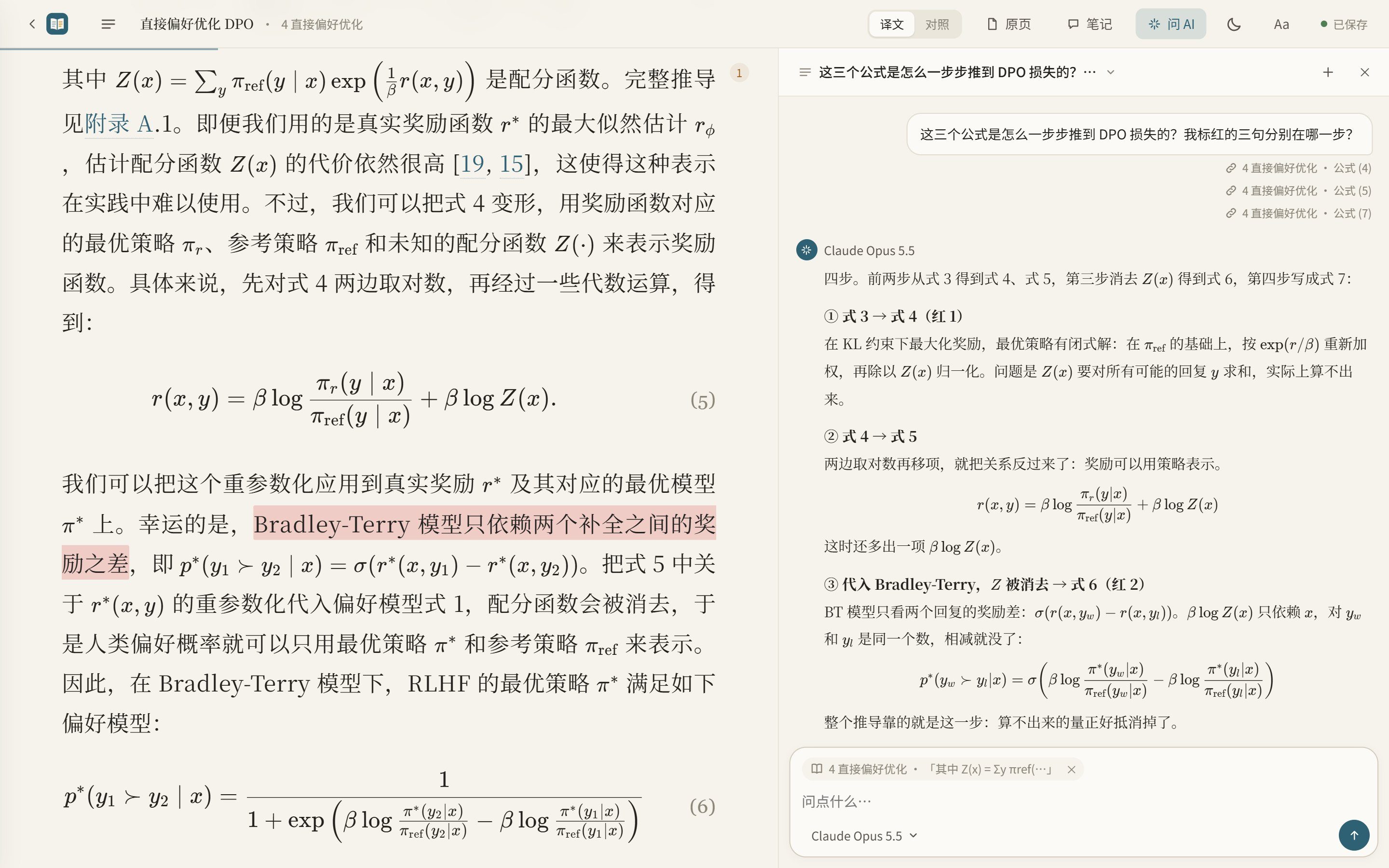
Ask AI panel

The original page, right beside you

The original page turns with your reading position and draws a box around the paragraph in the PDF. Unsure about an equation or table? One glance settles it.

Original page side by side

All annotations, in reading order

  • Your highlights, notes and questions
  • Typos found in the source during translation (e.g. two tables that disagree)
  • AI answers

Pick what you want and export it as Markdown for Obsidian or Notion.

Notes panel

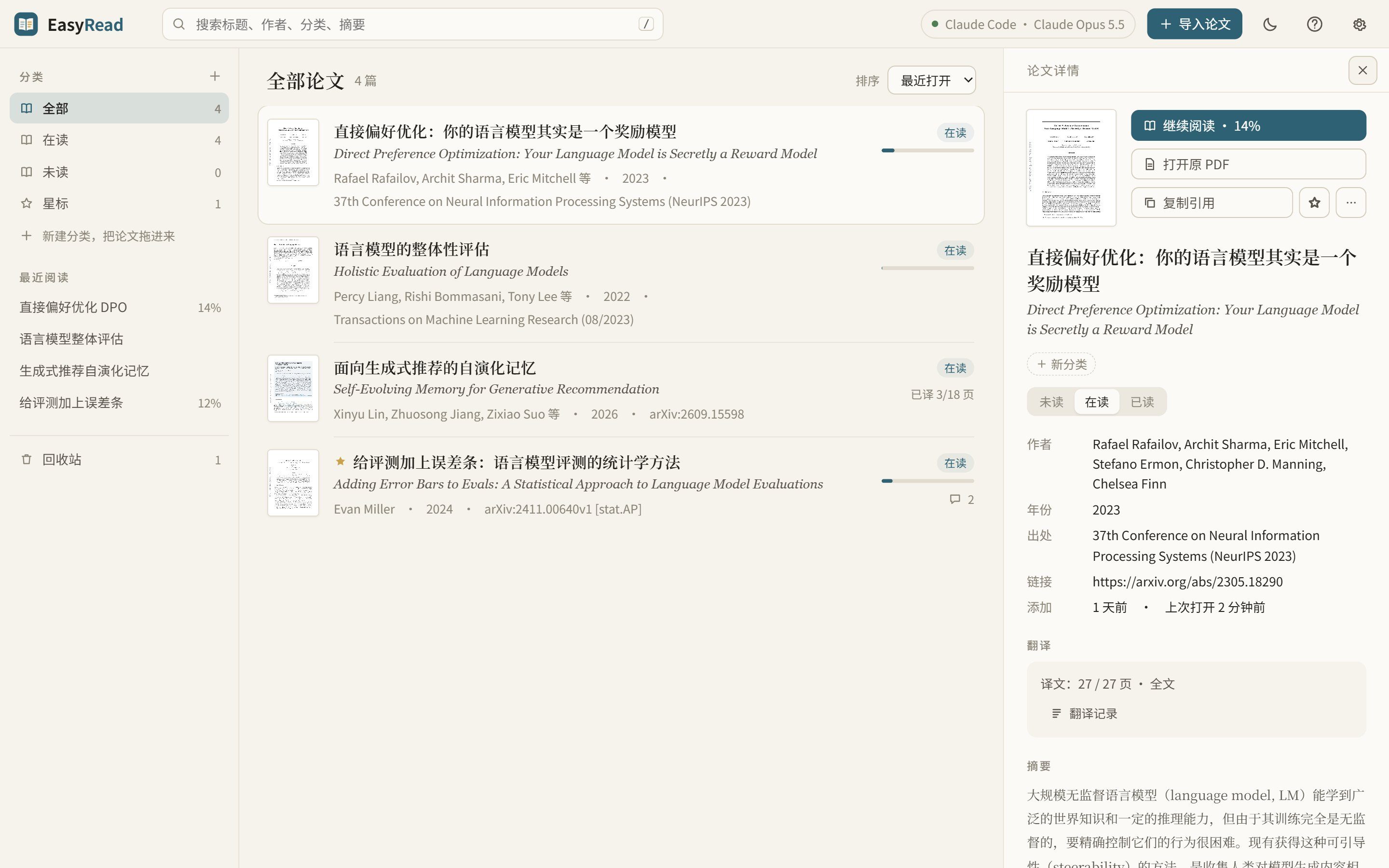
A library of your own

Pin papers and folders, drag papers into your own folders, see recent reads, stars and progress at a glance, copy citations (GB/T 7714, APA, BibTeX), and export a single-file offline page to share. Deleted papers go to a trash you can restore from.

Library

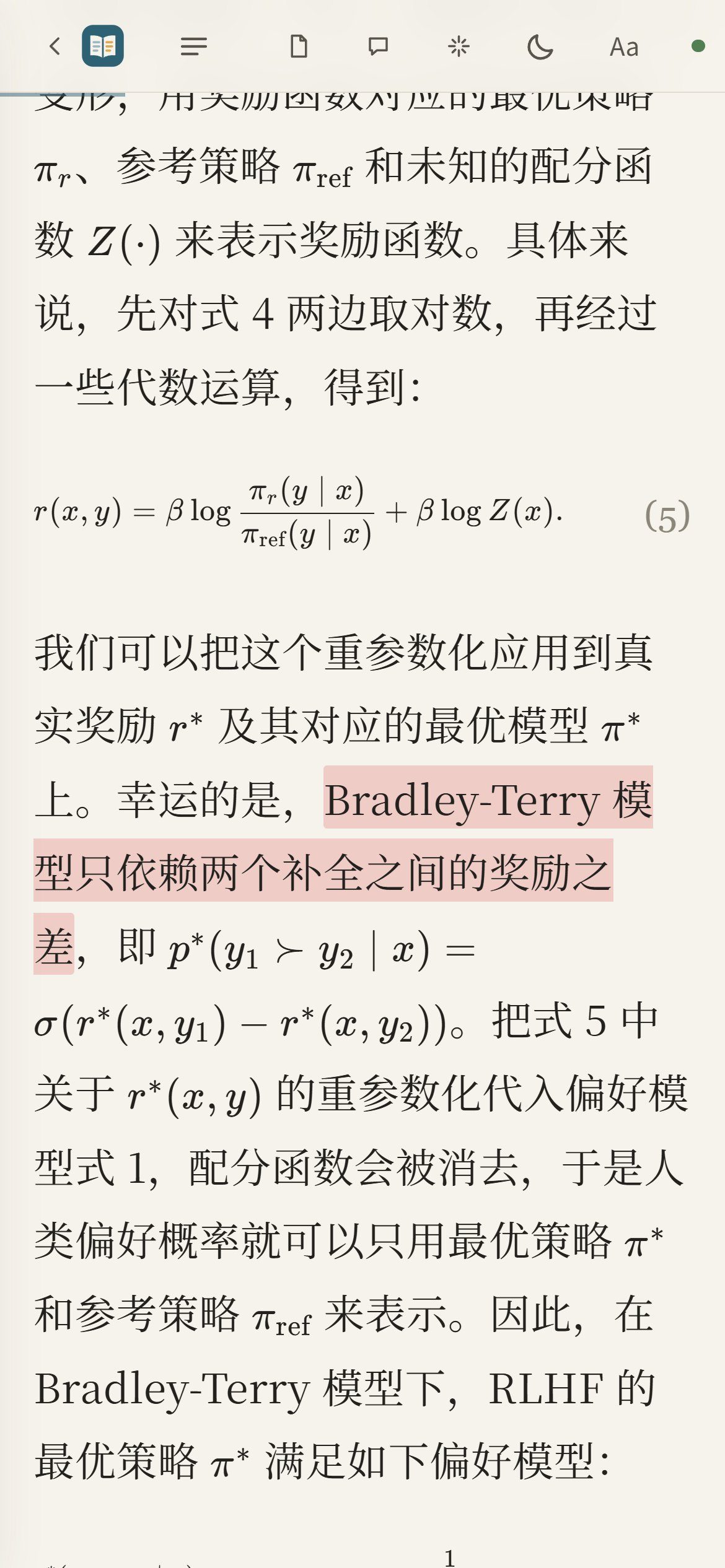
Works on your phone too

Exported offline pages and the live demo are mobile-friendly: keep reading on the commute, highlights included.

Reading on a phone

Pick your translation model

Settings detect what's installed; “Test one sentence” tells you right away if it works. Failed pages retry automatically, and if your quota runs out it pauses and picks up later. Token usage is recorded for every translation; with a Claude subscription you also see how much of the 5-hour quota is used.

SourceWhat you needNotes
Claude CodeRecommendedClaude Code installed and logged inNo API key, uses your subscription; checks equations against the page image. Best quality
Codex CLICodex installed and logged inNo API key, uses your ChatGPT account
API · China-directAPI keyDeepSeek, Zhipu, Alibaba Bailian, Kimi, SiliconFlow, ModelScope. Zhipu GLM-4.7-Flash and SiliconFlow's small models are free; DeepSeek costs cents per paper
API · InternationalAPI keyOpenAI, Anthropic, Gemini, OpenRouter, Groq, Cerebras; the last four have free tiers
API · LocalFreeOllama or LM Studio installedFully offline. qwen3.5:9b recommended (4b for small GPUs)
API · Custom endpointURL + keyAny OpenAI-compatible API or relay; “Fetch model list” pulls the model names for you

Up and running in three steps

Easiest: download the installer. No Python needed, for Windows, macOS (Apple silicon) and Linux.

Download and install

Grab the Windows .exe, macOS .dmg or Linux .AppImage from Releases; it opens in its own window. Or run from source (Python 3.10+): double-click start.cmd on Windows, run ./start.sh on macOS / Linux.

Choose a model

Open Settings (top right), pick Claude Code, Codex CLI or an API (DeepSeek, Zhipu, local Ollama…), and hit “Test one sentence”.

Import a paper and read

Drag in a PDF or paste an arXiv ID or link. Translated pages are readable right away; the rest show the original.

Or with pip:

pip install git+https://github.com/Edwardxlai/easyread
easyread

FAQ

Does it cost anything?

EasyRead itself is free and open source. Translation runs on your own model: Claude Code / Codex use your existing subscription, local and free-tier models cost nothing, paid APIs bill per use.

Where are my papers and notes? Is anything uploaded?

Everything stays on your machine, one folder per paper with the original PDF, page images and a few JSON files. Only the text being translated or asked about is sent to the model you picked.

Can it translate into other languages?

Not yet. Prompts, typography and the interface are all tuned for Chinese. Issues and pull requests are welcome on GitHub.

Can I share a paper with someone who doesn't have EasyRead?

Yes. Right-click a paper → “Export offline HTML” for a single-file web page; they double-click to open it in a browser, with the translation, equations, page images, your highlights and notes included. Page images are embedded, so it's not small (about 10 MB for a 27-page paper).

Are highlights in the live demo saved?

They're saved in your own browser and nobody else sees them. The demo can't import papers or ask AI; install it locally for the full feature set.